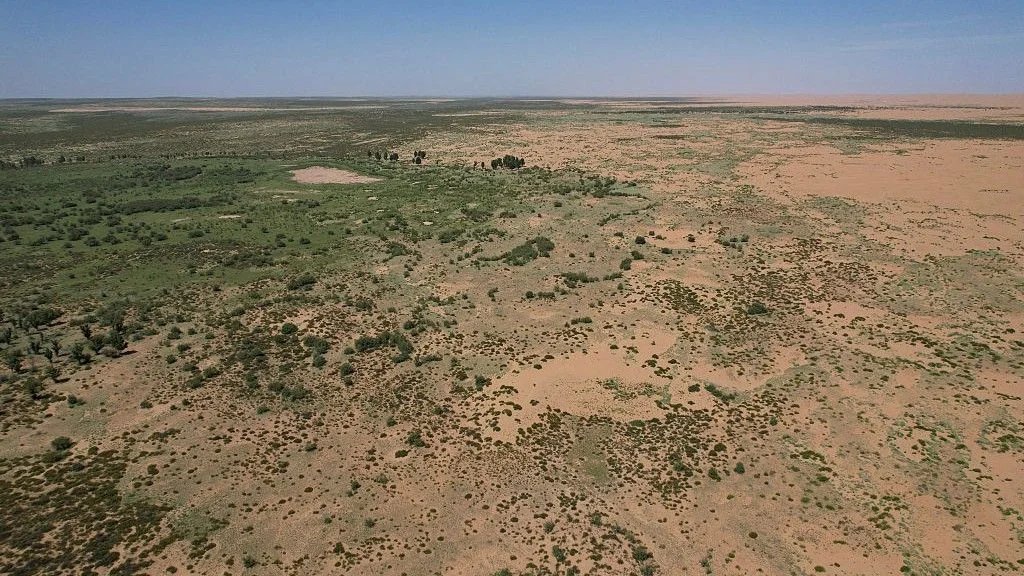
China’s efforts to slow land degradation andclimate changeby planting trees and restoring grasslands have shifted water around the country in huge, unforeseen ways, new research shows.
Between 2001 and 2020, changes in vegetation cover reduced the amount of fresh water available for humans and ecosystems in the eastern monsoon region and northwestern arid region, which together make up 74% of China’s land area, according to a study published Oct. 4 in the journalEarth’s Future. Over the same period, water availability increased in China’s Tibetan Plateau region, which makes up the remaining land area, scientists found.
the و in و and – تفاصيل مهمة
Three main processes move water between Earth’s continents and the atmosphere: evaporation and transpiration carry water up, while precipitation drops it back down. Evaporation removes water from surfaces and soils, and transpiration removes water that plants have absorbed from the soil. Together, these processes are called evapotranspiration, and this fluctuates with plant cover, water availability and the amount of solar energy that reaches the land, Staal said.
“Both grassland and forests generally tend to increase evapotranspiration,” he said. “This is especially strong in forests, as trees can have deep roots that access water in dry moments.”
China’s biggest tree-planting effort is the Great Green Wall in the country’s arid and semi-arid north. Started in 1978, the Great Green Wall was created to slow the expansion of deserts.
Over the last five decades, it has helped grow forest cover from about 10% of China’s area in 1949 tothan 25%today — an area equivalent to the size of Algeria. Last year, government representatives announced the country had finished encircling its biggest desert with vegetation, but that it will continue planting trees to keep desertification in check.
the و in و to – تفاصيل مهمة
Other large regreening projects in China include the Grain for Green Program and the Natural Forest Protection Program, which both started in 1999. The Grain for Green Program incentivizes farmers to convert farmland into forest and grassland, while the Natural Forest Protection Program bans logging in primary forests and promotes afforestation.
Collectively, China’s ecosystem restoration initiativesaccount for 25%of the global net increase in leaf area between 2000 and 2017.
But regreening has dramatically changed China’s water cycle, boosting both evapotranspiration and precipitation. To investigate these impacts, the researchers used high-resolution evapotranspiration, precipitation and land-use change data from various sources, as well as an atmospheric moisture tracking model.
the و and و China’s – تفاصيل مهمة
The results showed that evapotranspiration increased overall than precipitation did, meaning some water was lost to the atmosphere, Staal said. However, the trend wasn’t consistent across China, because winds can transport waterup to 4,350 miles (7,000 kilometers)away from its source — meaning evapotranspiration in one place often affects precipitation in another.
The researchers found that forest expansion in China’s eastern monsoon region and grassland restoration in the rest of the country increased evapotranspiration, but precipitation only increased in the Tibetan Plateau region, so the other regions experienced a decline in water availability.
“Even though the water cycle is active, at local scales water is lost than before,” Staal said.
in و the و water – تفاصيل مهمة
This has important implications for water management, because China’s water is already unevenly distributed. The north has about 20% of the country’s water but is home to 46% of the population and 60% of the arable land, according to the study. The Chinese government is trying to address this; however, the measures will likely fail if water redistribution due to regreening isn’t taken into account, Staal and his colleagues argued.
Ecosystem restoration and afforestation in other countries could be affecting water cycles there, too. “From a water resources point of view, we need to see case-by-case whether certain land cover changes are beneficial or not,” Staal said. “It depends among other things on how much and where the water that goes into the atmosphere comes down again as precipitation.”
Disclaimer: This news article has been republished exactly as it appeared on its original source, without any modification. We do not take any responsibility for its content, which remains solely the responsibility of the original publisher.
Author:[email protected] (Sascha Pare)
Published on:2025-12-03 19:36:00
Source: www.livescience.com
Disclaimer: This news article has been republished exactly as it appeared on its original source, without any modification.
We do not take any responsibility for its content, which remains solely the responsibility of the original publisher.
Author: uaetodaynews
Published on: 2025-12-03 23:35:00
Source: uaetodaynews.com