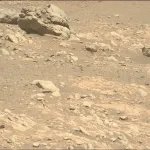



The Mars rover was able to find this rock, which is 80 centimeters wide, in the “Vernoden” area inside the “Jezero” crater, and named it “Vipsaxla.” It caught the attention of scientists with its unique shape and unusual chemical composition.
NASA published two pictures of the rock showing it from different distances. What makes “Vipsixla” strange in its geological environment is its unique chemical composition, as analyzes revealed that it is rich in iron and nickel, which indicates that it is not one of the original Martian rocks, but rather it is most likely a meteorite that collided with the planet in the distant past.
This rock belongs to the category of iron and nickel meteorites. It is rare compared to rock meteorites, and is usually formed from the cores of large asteroids in the early stages of the formation of the solar system.
Scientists first noticed the distinctive shape of the rock, as it stands out with its large size and uniquely carved appearance among the surrounding rocks. Using advanced Mastcam-Z cameras, the spacecraft captured detailed images of the rock.
The vehicle also used advanced Super Cam tools, using lasers and spectroscopy, to analyze the chemical composition of the rock, which confirmed that it contains a high percentage of iron and nickel.
Finding iron and nickel meteorites on the surface of Mars is common, as they have previously been found in multiple locations, but this is the first time that Perseverance has found such a meteorite.
Although studies are needed to confirm the nature of the meteorite, this discovery represents an important addition to the mission’s record of achievements. Perseverance is distinguished by being the first vehicle to collect samples of Martian rocks using an advanced drill, then store them for analysis in miniature laboratories.
If NASA determines the importance of these samples, they could be stored for return to Earth on future missions, as Perseverance cannot send the samples itself.
The vehicle has achieved great scientific achievements since its landing in February 2021, such as exploring the bottoms of ancient lakes, discovering amazing rocks, and searching for signs of past life.
The vehicle also set a record for the distance traveled on the surface of an extraterrestrial planet. It is still continuing its explorations without a specific date for the end of its mission, which heralds new discoveries that enrich our understanding of the Red Planet and its history.
Source: Space
Deep space flight requirements
Mikhail Kovalchuk, head of the Kurchatov Institute, notes that future Mars missions will require developing new types of space engines, establishing a base on the Moon and learning how to live and work on it.
Shocking facts about the fate of the first settlers on Mars
International space companies are striving to achieve the dream of establishing the first human colony on Mars. But behind these ambitious plans lies a fierce existential battle against a harsh and unforgiving space environment.
Disclaimer: This news article has been republished exactly as it appeared on its original source, without any modification. We do not take any responsibility for its content, which remains solely the responsibility of the original publisher.
Author:
Published on:2025-11-18 18:47:00
Source: arabic.rt.com
UAETodayNews delivers the latest news and updates from the UAE, Arab world, and beyond. Covering politics, business, sports, technology, and culture with trusted reporting.
Disclaimer: This news article has been republished exactly as it appeared on its original source, without any modification. We do not take any responsibility for its content, which remains solely the responsibility of the original publisher.
Author: uaetodaynews
Published on: 2025-11-18 14:59:00
Source: uaetodaynews.com